

Introduction — Why Cranberry Bogs and Spiders?
Cranberry bogs are more than neat rows of ruby fruit — they’re living laboratories. For ecologists, zoologists, and curious biology students, bogs host intricate food webs and species adapted to saturated soils and shifting water tables. This article walks you through a focused, field-ready look at those often-overlooked residents: the spiders that live, hunt, and reproduce in cranberry bogs. Along the way we’ll point out what to look for in the cranberry bog spiders video, how to interpret behavior, and how to use footage in research or teaching.
 Cranberry Bog Spiders: What You Need to Know
What Are Cranberry Bogs? (Habitat Overview)
Cranberry bogs are wetland systems that may be natural or human-managed for cranberry production. They’re characterized by saturated peat or sandy soils, standing water at times, and low-lying vegetation — sphagnum moss, sedges, and the cranberry vines themselves. For spiders, this habitat means a patchwork of micro-sites: drier ridges, soggy hollows, open water margins, and dense vegetation mats — each with distinct prey communities and microclimates.
Cranberry Bog Spiders Size and Habitat
Hydrology and Vegetation
Water regime matters. Flooded periods reduce some predators but favor others; droughts compress the microhabitats and concentrate prey. Vegetation provides anchor points for web builders and cover for ambush hunters. When you watch the video, note which micro-habitats spiders choose — that’s a behavioral clue to species and hunting strategy.
Who Lives There? — Spider Families in Cranberry Bogs
Bog spider communities are usually a mixture of ground-active hunters and small web builders. Two broad groups commonly appear in bog footage: active hunters (like wolf spiders) and sheet or tangle web species that exploit low vegetation. Many species are small and fast — camera patience is required!
Wolf Spiders and Ground Hunters
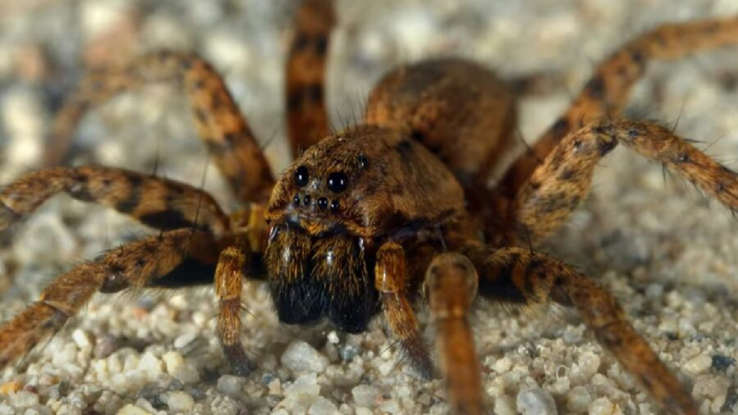
Wolf spiders (family Lycosidae) are classic bog residents. They don’t build capture webs; instead they chase or ambush prey. Look for stocky bodies, long legs, and a rapid, purposeful gait. In the video, wolf spiders are often filmed hunting at dawn/dusk or scuttling across mossy ridges. They’re ecologically important top invertebrate predators in these systems.
Discovering Bog Spiders in Cranberry Fields
Other Bog-Dwelling Spiders
Tiny sheet weavers (Linyphiidae) and cobweb weavers (Theridiidae) may hide in vegetation or build low, horizontal sheets that trap small flies and springtails. These species can be ecosystem indicators — their presence and abundance tell us about microclimate and prey availability.
Behavioral Ecology: Foraging, Mating, and Seasonality
Behavior is what brings footage to life. In bogs, seasonal wetness, prey pulses (like spring emergences), and temperature determine spider activity. You’ll see hunting, courtship dances, egg sac guarding, and juveniles dispersing by “ballooning.” Each behavior gives clues about life history strategies and energy budgets in these challenging habitats.
Hunting Strategies
Active hunters (wolf spiders) sprint, pounce, and stalk; sit-and-wait ambushers hide near prey trails. Web-builders rely on silk architecture to intercept flying or jumping prey. In video, compare the movement signatures: purposeful, straight-line sprints vs sudden lunges and the oscillatory movement of web vibrations.
What to Do If a Cranberry Bog Spider Is On You
Mating Rituals and Egg Sacs
Mating displays can be surprisingly elaborate — visual signals, vibrations, and tactile exchanges. Wolf spider males may tap or bob to court females; females often carry egg sacs or guard hatchlings. Spotting these in the cranberry bog spiders video provides valuable natural-history footage.
Why Spiders Matter to Cranberry Ecosystems
Spiders are pest-suppression allies. They consume aphids, leafhoppers, and other invertebrates that might otherwise damage cranberry crops. Beyond pest control, they are prey for birds and amphibians and influence nutrient flow by breaking down insect biomass. The video highlights how spider behavior connects to broader ecological processes — a perfect teaching tool for applied ecology.
The Video: How It Was Shot
Our cranberry bog spiders video was designed to be both captivating and scientifically useful. Successful wildlife videography in bogs balances attention to detail with minimal disturbance. Below we unpack the technical and field techniques that yielded close, stable footage without harming the habitat or animals.
Equipment & Settings
Macro-capable cameras or mirrorless bodies with 90–105mm macro lenses are ideal. A tripod with a low-profile, waterproof base or a beanbag stabilizer helps steady shots on uneven moss. Use manual focus for predictable close-ups; a small aperture (f/8–f/16) increases depth of field but needs more light or slower shutter speeds — balance accordingly. For motion, 60–120 fps is useful for slow-motion playback of hunting sequences.
Field Techniques & Timing
Early morning or late afternoon are the sweet spots — cooler temperatures and active spiders. Walk slowly to avoid collapsing moss mats, and set cameras ahead of time to reduce disturbance. Use natural light whenever possible; if you need fill light, diffuse LEDs at low intensity. Capture several habitat types: open moss, vine mats, water edges — this increases the chance of encountering multiple species.
What You’ll See in the “cranberry bog spiders video”
Expect a mix of close-up hunting sequences, wide habitat shots, and slow-motion detail of leg movement and silk manipulation. Notice the following: the gait of ground hunters, how web-builders orient their sheets to wind, and female spider behavior around egg sacs. The video also highlights seasonal contrasts — spring for juvenile emergences and late summer for adult courtship.
Identifying Species from Video Footage
Species ID from video is tricky but doable with attention to key features: eye arrangement, leg spination, body proportions, and movement patterns. Wolf spiders have a distinctive eye pattern — large anterior median eyes and a rectangular eye row shape. Linyphiids are tiny and build horizontal sheet webs low to the ground. Combine morphological cues with behavior and habitat to narrow down possibilities.
Patterns, Colors & Size Clues
Coloration can be variable, so emphasize structural features: robust cephalothorax, leg length ratios, and abdominal shape. Use a scale reference (a blade of grass, a berry) for size estimation in your analyses. The cranberry bog spiders video includes scale references in many shots — a deliberate choice to help identification.
Safety, Ethics, and Permits When Filming in Bogs
Wetlands are protected in many jurisdictions. Always check local regulations and obtain permits when required. Ethical filming minimizes habitat trampling: use boardwalks, avoid stomping vegetation, and never collect more specimens than necessary. If filming for research, follow institutional animal-care and biosecurity protocols.
Using the Video in Research and Teaching
The video is a versatile resource. In classrooms, show short clips to illustrate predator–prey interactions, morphological adaptations, and ecosystem services. For citizen science, share timestamped clips and encourage viewers to note behavior, habitat, and approximate location — these observations can enrich distribution records. Researchers can extract frame-by-frame movement data for kinematic analyses or annotate footage for training species-recognition models.
Conservation Concerns & Threats to Bog Spiders
Cranberry bogs face threats from drainage, pesticide use, and conversion to agriculture. Even managed bogs can support diverse spider communities if conservation-friendly practices are used. The video subtly underscores the vulnerability of bog invertebrates — small changes in hydrology or chemical input can cascade through the food web.
Conclusion — What the Video Teaches Us
A good field video is more than pretty pictures — it’s a bridge between observation and understanding. The cranberry bog spiders video shows how close observation illuminates behavior, ecology, and the roles spiders play in wetland systems. For biologists, educators, and curious naturalists, footage like this becomes a portable lab: watch, note, hypothesize, and share.
FAQs
Q1: What species are most commonly seen in cranberry bogs?
A1: Ground-active hunters like wolf spiders (Lycosidae) and small web-building families (Linyphiidae, Theridiidae) are commonly observed, though exact species vary by region and bog type.
Q2: Can footage from the cranberry bog spiders video be used for scientific publication?
A2: Yes — if metadata (location, date, time, camera settings) are recorded and ethical/permit requirements are met, video can support natural-history notes, behavior descriptions, and kinematic analyses.
Q3: How can teachers use the video in the classroom?
A3: Short clips illustrate hunting strategies, silk use, and reproductive behavior. Pair clips with guided questions, identification keys, or a citizen-science assignment to collect local observations.
Q4: Are cranberry bog spiders harmful to humans?
A4: Most bog spiders are harmless to people. Bites are rare and usually minor; spiders are more beneficial than dangerous because they reduce pest insects.
Q5: How can I help conserve spider biodiversity in bogs near me?
A5: Support wetland protection, minimize pesticide use, promote native vegetation buffers, and engage in citizen science projects that monitor invertebrate diversity.
Are cranberry bog spiders dangerous?
Discover the mysterious world of cranberry bog spiders in our exclusive video journey. 🌿🕷 Dive deep into nature’s hidden marvels!